 Small But Mighty
Payday super, minimum wage rises, SMS sender ID rules and tax changes. Here’s every July 1 change Australian businesses need to know.
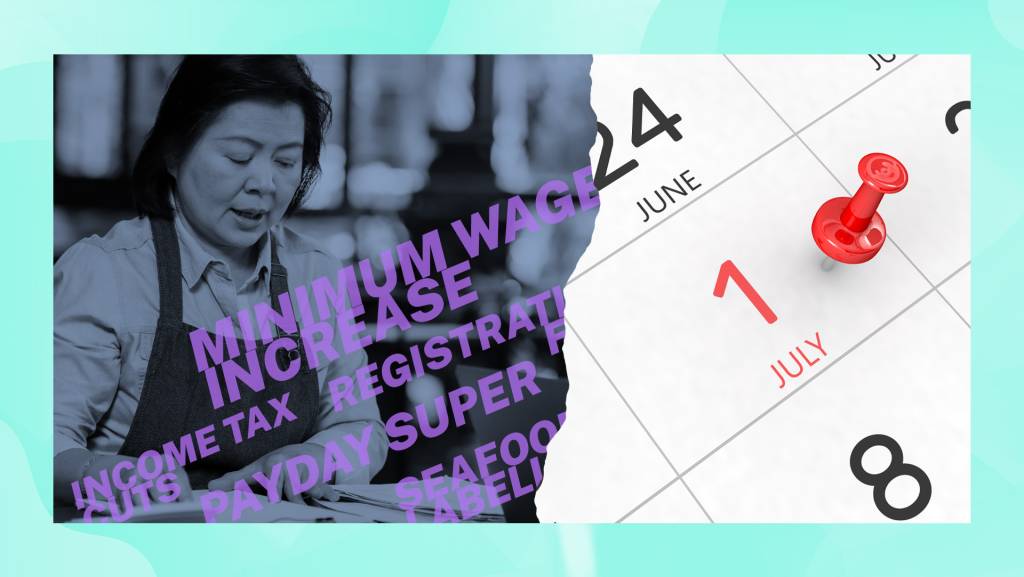
Image: SmartCompany
The start of every new financial year brings with it a whole host of changes for businesses, and this year is no different.
From the biggest shake-up to the Australian superannuation system since its inception, to new rules around branded text messages and country of origin labelling for seafood, there’s plenty of changes for business owners to understand.
And then there are the tweaks affecting millions of taxpayers.
Here’s a list of the national July 1 changes that we know are coming, the ones that may be on the way, and some key state-based reforms too.
Confirmed July 1 changes for all Australian businesses
Payday superannuation
From July 1, all Australian employers will need to pay their staff superannuation much more frequently than they do now.
Under the new system, known as payday super, employers must pay their workers’ superannuation guarantee (SG) into their super funds at the same time they process payroll, instead of paying SG quarterly.
Businesses must ensure SG is paid into a worker’s super fund within seven business days of the day they are paid.
The new payday super system has been in the works for some time, with the federal government arguing that more regular SG payments will make it harder for employers to skimp on employee entitlements.
However, small business groups have raised a number of concerns about the implementation of the new system and asked for more time for small businesses to get ready.
These concerns centre around the time it may take for super clearing houses or super funds to actually process the payments, and businesses facing potential penalties if there is a hold-up by a third party.
The Australian Taxation Office will oversee the payday super system and has said it will not penalise businesses that strive to do the right thing over the first year.
At the same time, concerns have also been raised about how the Fair Work Ombudsman may deal with late super payments under the new system, given the watchdog’s oversight over employee entitlements more generally.
Closure of the Small Business Super Clearing House
The introduction of payday super will happen at the same time as the closure of the Small Business Super Clearing House.
The free clearing house was relied on by many Australian small businesses, as it allowed employers to pay super contributions for multiple employees in one place and avoid having to deal with each individual super fund.
From July 1, the clearing house will close permanently. In its place, businesses will need to use modern payroll software that does the same function, or commercial clearing house providers that link up directly with Single Touch Payroll (STP).
The government first announced it intended to close the free service back in September 2024, and since October 2025, only existing users have been able to access the clearing house.
Minimum wage increase
The National Minimum Wage will rise by nearly 6% to $26.44 an hour from July 1.
This equates to $1,004.90 per full 38-hour working week, marking a significant wage increase for Australia’s lowest-paid workers above inflation.
The current National Minimum Wage is $24.95 per hour, or $948 per 38-hour work week.
That rate applies to workers not covered by a modern award or enterprise agreement, and its use is relatively limited.
However, the Fair Work Commission also agreed to lift pay rates under modern awards by 4.75%, covering millions more Australians.
$1,000 instant tax deduction
The 2026-27 budget papers included a boost to the ‘instant’ tax deduction for work-related expenses, bringing it up to $1,000.
This lifts the value of eligible expenses taxpayers can deduct from their assessable income, without providing receipts, from its current level of $300.
This measure passed into law on Thursday, just in time for the July 1 deadline.
Next phase of income tax cuts
From July 1, 2026, the tax rate on income between $18,201 and $45,000 will drop from 16% to 15%.
The federal government states this change will result in an annual income tax cut of up to $268 compared to tax settings over the 2024-25 period.
Another tax cut is yet to come: From July 1, 2027, the tax rate on that bracket will drop to 14%.
End of ATO fuel response repayment plan eligibility
Businesses planning to take advantage of the ATO’s temporary repayment plans have until June 30 to file their application.
That plan, instituted in response to the fuel crisis, allows eligible businesses to lock in three-year repayment schemes, potentially avoiding sterner repayment conditions down the line.
Read more here.
Government-funded paid parental leave expansion
Eligible parents can access 130 days of government-funded leave, up from 120 days, to care for children born or adopted after July 1, 2026.
That equates to 26 weeks of leave, paid at the minimum wage (see above), based on a five-day work week.
Days of leave reserved for a partner will rise from 15 to 20, while single parents will have access to all 130 days.
This measure comes on top of any paid parental leave employers may choose to offer.
More information is available via Services Australia.
Supermarket price gouging law
The ACCC will be monitoring supermarket pricing starting on July 1 when its excessive pricing prohibition rules come into play.
The prohibition only applies to large supermarkets that have an annual revenue exceeding $30 million. For now, this means that it only applies to Woolworths and Coles.
More information is available on the ACCC website.
SMS sender IDs
New anti-scam rules related to sender IDs for branded text messages kick in on July 1.
Overseen by the Australian Communications and Media Authority (ACMA), the changes will see text messages that are sent using unregistered branded sender IDs appear as “Unverified”, instead of displaying the business name.
These text messages may then be grouped alongside other potential scam texts.
Businesses were given until May 15 to safely register their sender IDs, in order to be ready for the July 1 deadline.
Those who missed this deadline can still register; however, their applications may not be approved in time before the July 1 rollout.
Find out more on the ACMA website.
AML/CTF changes
Australia’s anti-money laundering and counter-terrorism financing (AML/CTF) laws will expand to more types of business when the second tranche of reforms begins on July 1, 2026.
This includes accountants, lawyers, conveyancers, real estate agents, and precious gem dealers, when they provide services designated under AML/CTF obligations.
In broad strokes, those businesses will need to undertake initial customer due diligence, monitor transactions to identify suspicious payments, report on certain payments to AUSTRAC, and undertake regular AML/CTF training.
Businesses covered should review their obligations through AUSTRAC.
Temporary fuel excise cut extension
The federal government’s temporary fuel excise relief will continue into the new financial year, but at a lower rate.
From July 1 to August 2, 2026, fuel excise on petrol and diesel will be reduced by 16 cents per litre, down from the 32-cent discount that applied from April 1 to June 30.
The Heavy Vehicle Road User Charge will also be reduced by 16 cents per litre over the same period.
The government says the extension will shave around $11 off the cost of filling a typical 65-litre tank, and has costed the measure at around $400 million.
The ACCC and other regulators will continue monitoring prices to ensure the lower excise is being passed through to motorists and businesses.
Business name registration fees
The cost of registering or renewing a business name is also increasing from July 1, 2026.
For one-year renewals, the fee will increase from $45 to $47. For three-year renewals, business owners can expect to pay $108, up from $104 the year before.
More information about business name registrations or renewals can be found on the Australian Securities and Investments Commission (ASIC) website here.
Company registration and renewal fees
Company registration and annual review fees have also been indexed and will increase on July 1.
For company registrations, the cost will increase from $611 to $636, while annual renewal fees for proprietary companies will increase from $329 to $342.
More information is available on the ASIC website.
Increase in superannuation concessional caps and non-concessional caps
Super contribution caps are increasing from July 1, giving business owners and employees a little more room to contribute to super in a tax-effective way.
According to the ATO, the annual concessional (before-tax) contribution cap will increase from $30,000 to $32,500.
The non-concessional (after-tax) contribution cap will also rise, from $120,000 to $130,000. The ATO says the amount people can contribute under the bring-forward rules will increase as well.
The general transfer balance cap, which limits how much super can be moved into a tax-free retirement pension, will increase from $2 million to $2.1 million. That change will also affect some super balance thresholds and contribution rules.
Unfair dismissal high-income threshold
Earning income past a certain point changes how workers engage with unfair dismissal protections.
Specifically, employees who are not covered by an award or agreement and earn above the high-income threshold are ineligible to apply for unfair dismissal.
On July 1, 2026, the threshold will lift from $183,100 to $190,100.
Employers should keep an eye on this threshold in the future.
The government plans to reform worker restraint clauses, including non-compete clauses, for workers earning under the threshold from 2027.
Country of origin labelling for seafood
The new country of origin labelling standard for seafood will apply to hospitality businesses from July 1.
Hospitality venues selling seafood for immediate consumption (including restaurants, cafes, pubs, clubs, takeaway outlets and food trucks) will need to indicate whether seafood is Australian, imported, or mixed origin.
This information must be shown clearly at the point of sale, including on menus and online ordering platforms.
Alcohol excise remission cap increase
Small alcohol manufacturers will get a modest excise relief boost from July 1.
This will raise the maximum annual alcohol excise remission cap from $350,000 to $400,000 for eligible manufacturers.
The higher cap applies to remission claims for eligible alcoholic beverages intended for home consumption on or after July 1, 2026.
National changes subject to legislation:
Permanent IAWO from 2026-27
After years of last-minute extensions every EOFY, the $20,000 instant asset write-off (IAWO) will become a permanent fixture of the Australian taxation system.
The instant asset write-off allows small businesses to instantly claim a tax deduction for eligible purchases up to the value of $20,000, instead of claiming depreciation on the asset over a number of years.
Loss carry-backs
According to the 2026-27 budget papers, companies with an aggregated annual turnover of less than $1 billion will be able to carry back a tax loss and offset it against the tax paid up to two years earlier.
“Loss carry back will apply to revenue losses only and will be limited by a company’s franking account balance,” the papers read.
Treasury has estimated that reintroducing loss carry-backs will decrease receipts by $2.3 billion over the five years from 2025–26.
If this sounds familiar, it’s because this is a COVID-era measure that the government is… carrying back. But it’s not as robust this time around.
State-based changes
NSW: Food waste separation
Under new laws, businesses that handle or sell food will need to separate food waste from general waste.
This will include supermarkets, cafes and hotels that have a weekly general waste capacity of:
- Six or more 660L bins
- 16 or more 240L bins
- Any combination of bins equal to or more than 3,960L
NSW: Building standards
From July 1, all repairs and renovations on class 3 and 9c buildings will come under the Design and Building Practitioners regime.
This will include the likes of boarding houses, group homes, and some residential care facilities.
Professional indemnity insurance will also be required for applicable tradies
VIC: Retail landlord leasing packs
Victorian landlords (and their representatives) must update leasing packs to include the new Retail Leases Information Brochure for Tenants by July 1.
According to the Victorian Small Business Commission, the brochure helps tenants understand their rights and responsibilities, as well as key lease terms, likely costs, and the questions to ask before signing.
VIC: Restrictions on NDAs in workplace sexual harassment cases
Late last year, the Victorian government passed legislation to restrict the use of NDAs when it comes to the settlement of workplace sexual harassment cases, from July 1.
QLD: Regional power bills
The Queensland Competition Authority has confirmed electricity costs will drop by up to 6.9% for regional households and 8.1% for small businesses from July 1.
WA: State minimum wage increase
Businesses that operate under the state industrial relations system will see a new minimum wage for employees 21 years and over. This will increase by 4.75% to $988.30 per week, or $26.27 an hour.
This will apply to sole traders, some micro businesses, unincorporated partnerships, and unincorporated trust arrangements.
Minimum wages for younger workers, award-free trainees, and apprentices will also increase.
WA: Container deposit scheme expansion
WA has released a proposed list of beverage products that will be brought into its container deposit scheme from July 1, 2026, expanding coverage beyond traditional drink containers.
Final regulations will determine exactly which containers are included and what obligations apply to suppliers and retailers.